Wake-on-LAN for the whole Apple family

One tap, and your computer wakes up.

MagicPing wakes PCs, Macs, NAS boxes, and servers on your home network – from your iPhone, Mac, Apple TV, and Apple Watch. And when you are done, it shuts them down again over SSH.

Press me – wake the gaming PC
Gaming PC
192.168.1.42
Offline
MAC 3C:7C:3F:A1:9B:04
iPhone iPad Mac Apple TV Apple Watch
Why MagicPing

There are plenty of Wake-on-LAN apps.
None of them think in your whole home.

Most WOL apps are a single iPhone app with a list. MagicPing is a family of apps that shows up wherever you actually need your computer.

Typical WOL app

  • iPhone only – retype your list on every device
  • Wakes only. Shutting down? Nope.
  • No place in the living room, no Watch, no Apple TV
  • Ads, accounts, or cloud servers in the background
  • "On or off?" – you get to guess

MagicPing

  • One list, synced via iCloud to iPhone, iPad, Mac, Apple TV & Watch
  • The full cycle: wake with a magic packet, shut down over SSH
  • Apple TV launcher for the couch, waking right from your wrist
  • No backend, no accounts, no tracking – passwords only in the keychain
  • Live status: see who's online – and for how long
What you actually need it for

Off while it sleeps.
There the moment you need it.

A computer running 24/7 burns power and patience. MagicPing lets it sleep – and wakes it at exactly the right moment.

Gaming from the couch

Turn on the Apple TV, tap "Gaming PC" in the launcher – MagicPing wakes it and shows you as soon as Sunshine responds. Then stream via Moonlight. The PC sits in the office, you sit on the couch.

Apple TV → Moonlight / Sunshine

Home-office machine

Wake your office Mac from the iPhone in the morning before you connect via Remote Desktop or SSH. In the evening MagicPing shuts it down again – the machine only runs while you work.

Wake · RDP/SSH · Shut down

NAS & media server

Plex, Time Machine backups, or your photo library live on the NAS? Wake it only when you need it instead of running it around the clock – and put it back to sleep when the movie ends.

Plex · Backups · Photo server

Home lab & quiet server

The tinkering server in the basement, the Windows box for that one game, the Linux machine for compiling. All in one list, live status at a glance – on or off with one tap, from any Apple device.

Multiple machines · Live status
Why MagicPing exists

Born from a real problem.
Not from a business plan.

MagicPing – like everything from cozysoft – is a hobby project of mine (hi, I'm Frank). It grew out of a very concrete need: I wanted to play the games running on my PC in the attic – comfortably, from the living-room couch.

I had actually been waiting for the Steam Machine – and you know how that turned out: too expensive for too little power. And with PCs barely affordable as of August 2026 (they certainly won't get cheaper), I upgraded my six-year-old machine instead. Now it flies again – easily good for another five years.

But that didn't solve my couch problem. Steam Remote Play never ran smoothly for me. There is an Apple TV in the living room though – and it's perfect for streaming games via Moonlight from a PC running Sunshine. One annoyance remained: climbing up to the attic before every session just to switch the PC on.

So I built my own fix: MagicPing. Finally.

— Frank

More from cozysoft

MagicPing is one of several hobby projects under the cozysoft umbrella — small apps that each solve one real everyday problem.

cozysoft.de →
The full cycle

Others only wake.
MagicPing also puts it back to bed.

For waking there's the magic packet. For shutting down MagicPing uses SSH – the password lives safely in the iCloud Keychain, never in the cloud database.

→ WAKE

Magic Packet

A UDP broadcast wakes any computer whose network card is listening for Wake-on-LAN. No software needed on the target – just the checkbox in BIOS/UEFI.

FF FF FF FF FF FF
3C 7C 3F A1 9B 04 ×16
→ Gaming PC starting up…
← SHUT DOWN

Cleanly over SSH

At the end of the day MagicPing shuts the machine down properly – Linux, macOS, and Windows with OpenSSH. User and command configurable per machine.

ssh frank@192.168.1.42
  shutdown -h now
🔒 password → iCloud Keychain
Before it works

Waking works right away.
Shutting down needs your permission once.

Waking only needs a checkbox in the BIOS. Shutting down is different: your computer will not let anyone switch it off from outside until you explicitly allow it. Five minutes of setup — once, and never again.

Do I have to do this? Only if you want to shut down as well. Waking, the list and the live status work with no setup at all.
🐧

Linux

You are allowing your user account to run the shutdown command without being asked. Everything below happens on the target computer itself — not on your iPhone.

  1. Open a terminal. Usually via your app overview, searching for “Terminal”.
  2. Type sudo visudo and press Enter. It asks for your password — nothing appears on screen while you type, which is normal. Press Enter.
  3. Use the arrow keys to move to the very bottom and add this line. Replace frank with your username:
frank ALL=(ALL) NOPASSWD: /usr/bin/shutdown, /usr/bin/systemctl
  1. Save and close. If the bottom line says “^O Write Out”, you are in nano: Ctrl+O, Enter, then Ctrl+X. If the screen looks bare, it is vi: press Esc, type :wq, press Enter.
  2. In MagicPing, set this as the computer’s command:
sudo shutdown -h now
🪟

Windows

Windows can accept remote commands but ships with the feature switched off. You turn it on — no terminal typing needed here.

  1. Settings → System → Optional features. Click “Add an optional feature”, search for OpenSSH Server and install it.
  2. Start the service: Windows+R, type services.msc, Enter. Double-click “OpenSSH SSH Server”, set the startup type to Automatic and click Start.
  3. Your Windows user must be an administrator (Settings → Accounts). Without that, Windows answers with “Access denied”.
  4. In MagicPing, set this as the computer’s command:
shutdown /s /t 0
🖥

Mac

Two steps: turn on remote access, then allow shutting down.

  1. Open System Settings → General → Sharing and turn on Remote Login.
  2. Open Terminal: ⌘+Space, type “Terminal”, press Enter.
  3. Type sudo visudo, Enter, then your password (the input stays invisible), Enter. Move to the very bottom and add this — with your username instead of frank:
frank ALL=(ALL) NOPASSWD: /sbin/shutdown
  1. Save: On a Mac this is the vi editor — press Esc, type :wq, press Enter.
  2. In MagicPing, set this as the computer’s command:
sudo shutdown -h now
If you see this message

Access denied as the requested operation requires interactive authentication

Your password is not wrong. Picture two keys: one opens the front door, the other the fuse box. The SSH password is the front-door key — that is how MagicPing gets in. But shutting down is the fuse box: for that, your computer wants to be asked explicitly, one more time.

Normally a window pops up for you to type your password into. MagicPing works in the background — there is no window there, and nobody to type. So the computer gives up. The NOPASSWD line above is the answer: it records, once and for all, that this user may run this one command without being asked.

Your SSH password, by the way, lives only in the iCloud keychain — never in the database that syncs between your devices.

One list. Every device.

Enter it once.
There everywhere.

Add a computer once on your iPhone or Mac – via iCloud it appears on all your devices. No account, no sign-up, no server run by us.

MagicPing launcher on Apple TV
The Apple TV launcher – the fastest way from couch to running gaming PC.
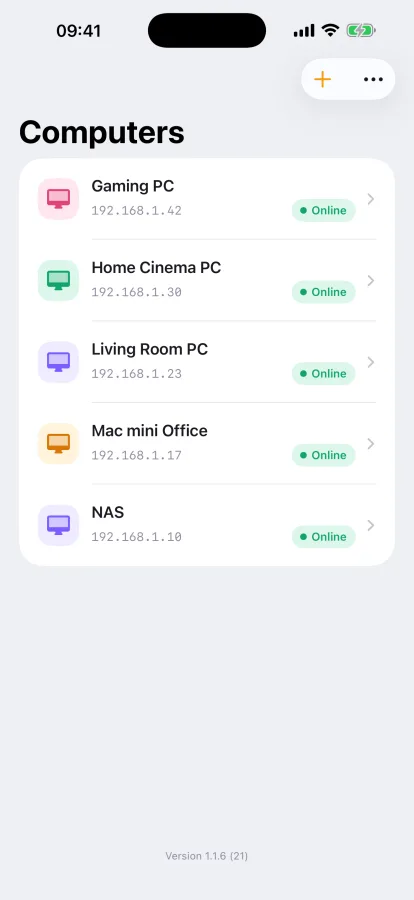
MagicPing on iPhone
iPhone · full management
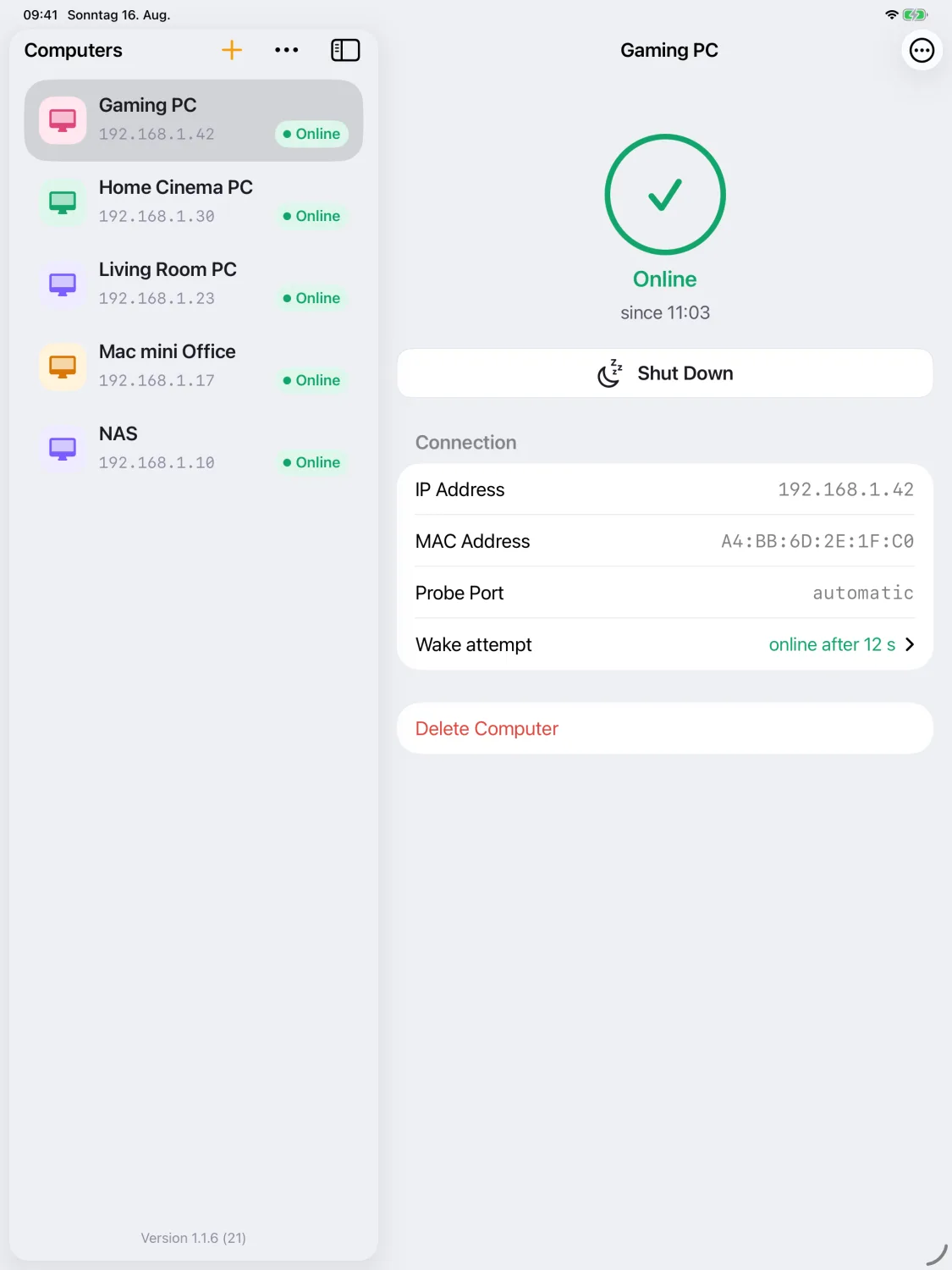
MagicPing on iPad
iPad · list and detail
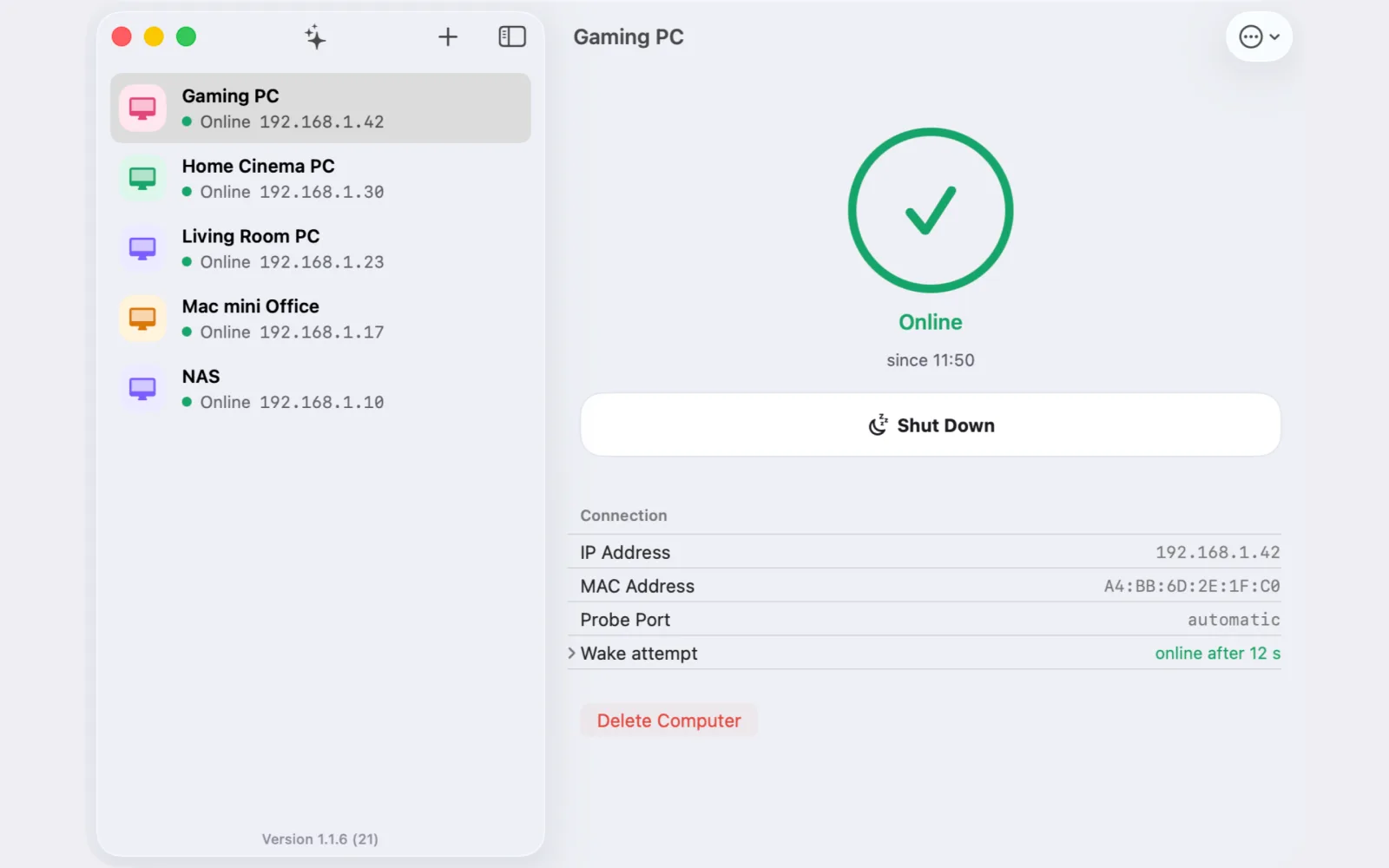
MagicPing on the Mac
Mac · split view
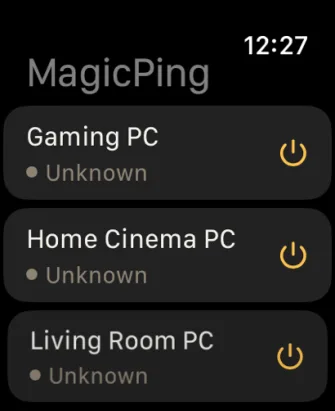
MagicPing on Apple Watch
Watch · from your wrist
Private by design

Your computers are nobody's business.
Least of all ours.

MagicPing has no backend of its own and collects no data. It only ever talks to the devices on your network.

No account, no server

No sign-in, no registration. There simply is no server of ours the app could talk to.

Passwords in the keychain

SSH passwords live exclusively in the iCloud Keychain – never in the synced database.

Your private iCloud

Your computer list lives in your private iCloud database. No tracking, no ads, no analytics.

Attention to detail

Small things that make the difference

Wake via magic packet

One or more machines with a single tap – as a UDP broadcast into your home network.

Live status "online for"

See at a glance who is reachable – and how long it has been up.

Shut down over SSH

Linux, macOS, and Windows with OpenSSH. Command configurable per machine.

Probe port, automatic

Sunshine, RDP, SSH, or SMB – pick one or let MagicPing detect it.

MAC without colons

Just type through – MagicPing inserts the separators for you.

iCloud sync

One list on all your devices – no account, no sign-up.

Frequently asked

Answered briefly

What it costs, what the computer needs, why shutting down gets stuck — the questions we actually get.

What does MagicPing cost?

MagicPing is free. There are no in-app purchases, no subscription, no ads and no paid features. One download covers iPhone, iPad, Mac and Apple Watch at once.

Which devices does MagicPing run on?

iPhone and iPad (iOS/iPadOS 17 or later), Mac (macOS 14 or later), Apple Watch (watchOS 10 or later) and Apple TV (tvOS 17 or later).

Do I need an account or a sign-in?

No. MagicPing has no user account and no server of its own. Your list of computers syncs through your private iCloud; the data lives in your iCloud database, not with us.

What does the computer need for waking to work?

The computer must support Wake-on-LAN and have it enabled in the BIOS or UEFI, and its network card must stay powered while the machine is off. On most PCs the setting is called “Wake on LAN”, “Power on by PCI-E” or similar. Wake-on-LAN rarely works over Wi-Fi — a cable is the reliable option.

Does it work when I am away from home?

The magic packet is a broadcast on the local network and does not leave your home network. It works remotely if your iPhone is connected to your home network over VPN — then it behaves like a device on the same network.

Why does shutting down fail?

To shut down, MagicPing sends an SSH command, and the target machine has to allow it. If it replies “Access denied as the requested operation requires interactive authentication”, your password is not wrong: sudo or Polkit wants an interactive confirmation that a background app cannot provide. The fix is a NOPASSWD line in the sudoers file plus the command “sudo shutdown -h now”. On Windows you need the OpenSSH server and an administrator account.

Where is my SSH password stored?

Only in your device’s iCloud keychain — never in the database that syncs between your devices, and never on a server of ours.

Can the Apple Watch wake a computer on its own?

The watch is a remote control for your iPhone: watchOS does not allow apps to send raw network packets, so the watch passes the wake command to the iPhone over WatchConnectivity, and the iPhone sends the magic packet. Watch and iPhone only need to reach each other — over Bluetooth or the same Wi-Fi.

Does MagicPing collect data about me?

No. The app has no backend, no tracking and no analytics. It only talks to the devices on your own network.

Now on Android, too

The Android version is ready.
Now I'm looking for testers.

MagicPing for Android is feature-equal to the iPhone app: wake with a magic packet, live status, and shutdown over SSH. Before it can go on the Google Play Store, Google requires a closed test with real people – and that's where you come in.

Joining is easy

Send me a short email with your Google account address (Gmail). I'll add it to the closed test, and you'll get MagicPing on your phone straight from the Play Store. That's all it takes – and you can opt out any time.

Sign up as an Android tester

Why the Gmail address? Google only unlocks the closed test for accounts I add in advance. I use it for that alone – no newsletter, no sharing.

Let your computer sleep.
Wake it when it counts.

Free. For iPhone, iPad, Mac, Apple TV, and Apple Watch.